A self-journal. Not a blog post with answers — a collection of better questions I keep coming back to.
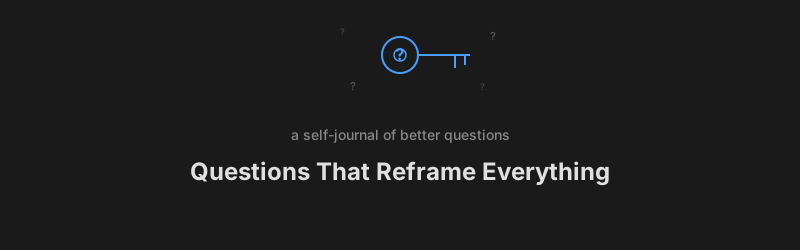
Inspired by Shaan Puri's "13 Questions That Will Change Your Life" — where he talks about questions being keys that unlock doors. I wanted to build my own keychain.
These are questions I've reframed for myself over time. The left column is how most people (including past me) would ask it. The right column is how I try to ask it now.
Time
My rule is simple: I only want to spend time doing one of three things — earning, learning, or relaxing. If something doesn't fall into one of these, it probably doesn't deserve my hours.
| Common question | Better question |
|---|
| How do I find more time? | What am I spending time on that isn't earning, learning, or relaxing? |
| Am I being productive enough? | Did I spend today on something that compounds — or something that just fills the clock? |
| How do I balance everything? | What if balance isn't 50/50 — what does the right ratio look like this season? |
| I don't have time for this. | What am I saying yes to by default that I should be saying no to? |
Money
Money, to me, is about one thing: freedom. Not luxury, not status — the ability to choose what I do with my time.
| Common question | Better question |
|---|
| How do I make more money? | What does freedom cost me — and am I earning toward that number? |
| Is this worth the money? | Is this buying me time, freedom, or neither? |
| When will I have enough? | What does "enough" actually look like — and have I written it down? |
| Should I save or invest this? | Am I optimizing for security or for optionality? |
Work & Craft
I choose work I enjoy. In difficult times, work has always been my anchor — you can't stop thoughts, but you can replace them with something more meaningful. I care about craft — doing things the right way, being opinionated for good reasons.
| Common question | Better question |
|---|
| Am I good at my job? | Am I still having fun doing this? If not — what changed? |
| What should I work on next? | What problem, if I solved it, would I be proud to talk about in 5 years? |
| How do I get promoted? | Am I building skills that matter even if I leave this place tomorrow? |
Relationships
Every relationship is a journey toward something — with the freedom to change direction when it's needed. The question is whether you're walking it honestly.
| Common question | Better question |
|---|
| Are we still on the same page? | Are we walking toward the same thing — and honest when the direction needs to change? |
| This person is difficult. | What are they going through that I'm not seeing? |
| How do I build trust? | Am I being the kind of person others can count on without thinking twice? |
| I don't feel understood. | Have I made it easy for them to understand me? |
| What kind of parent should I be? | What do I want my daughter to learn by watching me — not by hearing me? |
Growth & Learning
Learning truly happens only when there's a real change in behavior. Until then, it's just information — not growth.
| Common question | Better question |
|---|
| What should I learn next? | What did I learn last month that actually changed how I behave? |
| Am I growing fast enough? | Am I growing in the direction I actually care about? |
| How do I stay relevant? | What would I learn even if nobody was watching or paying me for it? |
| I read a lot but nothing sticks. | What's one thing I learned recently that I've actually done differently? |
Self & Identity
Happiness isn't a destination for me — it's the journey. If I have to name a goal, it's about being useful and maximizing that usefulness as much as possible. At least, that's what I know for now.
| Common question | Better question |
|---|
| What's my purpose? | Where am I most useful right now — and how do I do more of that? |
| Am I happy? | Am I living in a way where happiness shows up on its own? |
| What do people think of me? | Am I someone I'd respect if I met myself? |
| I don't know what I want. | What do I keep coming back to, even when nobody asks me to? |
| How do I find myself? | What would I do with my days if money and opinions didn't exist? |
This is a living document. I'll keep adding questions as I find better ones. The goal isn't to answer them all — it's to sit with the right ones long enough that clarity shows up on its own.
Because at the end of the day, the answers to these questions aren't things you can buy — they're things you build.
"A fit body, a peaceful mind, a house full of love. These things cannot be bought. They must be earned."
— Naval Ravikant