Your Agents Are Running. So Why Are You Still Exhausted?

In software engineering, cognitive load refers to the total amount of mental effort being used in a developer's working memory to complete a task. Think of it like the RAM in a computer: if you try to run too many heavy applications at once, the system slows down, glitches, or crashes.
When a developer's cognitive load exceeds their mental capacity, productivity drops, the quality of code suffers, and the risk of burnout increases.
The Three Types of Cognitive Load
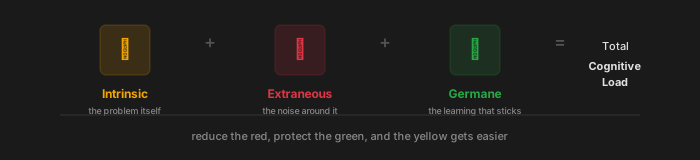
The concept, originally developed by educational psychologist John Sweller, is typically broken down into three distinct categories in a technical context:
| Type | Definition | Software Example |
|---|---|---|
| Intrinsic | The inherent difficulty of the problem itself. | Learning how a specific complex algorithm works or understanding a new programming language. |
| Extraneous | Mental effort spent on things that don't directly help the task. | Struggling with a confusing IDE, poorly documented legacy code, or complex deployment scripts. |
| Germane | The "productive" load used to create mental models and patterns. | Building a deep understanding of the business domain or architectural patterns that can be reused. |
Why It Matters in Software Development
In modern software environments, cognitive load has become a primary bottleneck. As systems move toward microservices, cloud-native architectures, and "you build it, you run it" philosophies, developers are often overwhelmed by the sheer volume of information they must hold in their heads.
Signs of High Cognitive Load
- Analysis Paralysis: Taking a long time to start a task because the system feels too "heavy" to touch.
- The "Fear" of Changing Code: Developers become afraid to refactor because they don't fully understand the ripple effects.
- Frequent Context Switching: Jumping between different domains, tools, or Slack interruptions shreds mental focus.
How to Manage and Reduce It
Managing cognitive load isn't about making the work "easy"; it's about clearing away the "noise" so developers can focus on the "signal."
- Limit Team Scope: Popularized by the book Team Topologies, this involves ensuring a single team isn't responsible for too many complex domains.
- Improve Developer Experience (DevEx): Investing in internal platforms, clear documentation, and "Golden Paths" reduces extraneous load (the "how do I deploy this?" struggle).
- Encourage Small, Decoupled Components: Smaller, well-defined services are easier to fit into working memory than massive, tangled monoliths.
- Standardization: Using consistent patterns and tools across a company allows developers to move between projects without having to relearn basic workflows.
The Golden Rule: If a developer has to spend 80% of their energy just figuring out how to run the environment or navigate the folder structure, they only have 20% left to actually solve the business problem.
The Psychology Behind the Load
To understand cognitive load from a psychological perspective, we have to look past the code and focus on the biological architecture of the human brain. While software engineering feels like a purely logical exercise, it is actually a high-stakes performance of human memory and attention.
1. The Working Memory Bottleneck
"The magical number seven, plus or minus two: some limits on our capacity for processing information." — George Miller, 1956
At the heart of cognitive load is Working Memory, the psychological "workspace" where we temporarily hold and manipulate information.
- The Constraint: In 1956, George Miller famously suggested that humans can hold roughly "chunks" of information at once. Modern research suggests this might be as low as 3 to 5 chunks for complex tasks.
- The Engineering Connection: When a developer looks at a function that has 15 different variables, 4 nested loops, and 3 external API calls, they are physically exceeding their working memory capacity.
- The Result: "Cognitive Overflow." This is the moment a developer says, "Wait, what was I doing?" Their brain literally ran out of temporary storage, and the previous context was overwritten.
2. Schema Theory: How Experts "Cheat" the Load
Psychologists define a Schema as a mental structure that organizes categories of information and the relationships among them. This is the difference between a junior and a senior engineer.
- Chunking: An expert doesn't see "an
ifstatement, aforloop, and atry-catchblock." They see a "Circuit Breaker Pattern." By grouping individual items into a single mental schema, they reduce 10 chunks of information into 1. - Germane Load as Investment: Germane load is the mental effort spent building these schemas. When you struggle to learn a new architectural pattern, you are performing "productive" psychological work that will lower your intrinsic load in the future.
3. Dual Process Theory (System 1 vs. System 2)
Popularized by Daniel Kahneman, this theory suggests our brains operate in two modes:
| Mode | Psychological Effort | Role in Engineering |
|---|---|---|
| System 1 (Fast) | Automatic, intuitive, and effortless. | Recognizing a syntax error or typing common commands like git status. |
| System 2 (Slow) | Deliberate, logical, and exhausting. | Debugging a race condition or designing a distributed system. |
"Thinking is to humans as swimming is to cats. They can do it, but they'd prefer not to." — Daniel Kahneman, Thinking, Fast and Slow The Psychological Angle: High Extraneous Load (bad tools, loud offices, messy code) forces a developer to stay in System 2 for tasks that should be System 1. This is why a developer can feel physically exhausted after 8 hours of "just sitting at a desk"—they have depleted their limited pool of "Executive Function" resources.
4. The Flow State and Attentional Blink
The ultimate goal in software engineering is the Flow State (proposed by Mihaly Csikszentmihalyi)—a psychological state of deep "immersion."
- Interruption Cost: When a developer is in flow, they have built a fragile "house of cards" in their working memory.
- Attentional Blink: When a Slack notification or a meeting request pops up, the brain undergoes a "switch cost." It can take upwards of 20 minutes to rebuild that specific mental model.
- Cognitive Friction: High extraneous load acts as "friction" that prevents the brain from ever reaching the flow state, leading to frustration and lower job satisfaction.
5. The Psychological Impact
| Psychological Aspect | Impact on Software Engineering |
|---|---|
| Cognitive Fatigue | Decisions made late in the day are often of lower quality (Decision Fatigue). |
| Anxiety & Stress | High intrinsic load without support leads to "imposter syndrome" and burnout. |
| Sense of Agency | When cognitive load is managed, developers feel "in control," which is a primary driver of mental well-being. |
Psychological Insight: We don't "write" code; we "model" it in our minds and then transcribe it. The bottleneck is never the typing speed; it is the mental modeling speed.
The Agentic Shift

"Automation does not replace human work. It changes it — often making it harder." — Lisanne Bainbridge, Ironies of Automation, 1983 In the era of Agentic AI, the narrative of cognitive load shifts from "The Burden of Creation" to "The Burden of Orchestration." If traditional software engineering is like being a lone writer at a desk, managing multiple AI agents is like being the director of an experimental theater troupe: you aren't writing every line anymore, but you are responsible for the coherence, timing, and "hallucination" control of every actor on stage.
1. The Psychological Shift: Builder → Director
In a traditional workflow, your cognitive load is primarily creative. You hold the logic in your mind and transcribe it. With multiple agents, your role shifts toward evaluative load.
The "Reviewer's Fatigue" (The System 2 Trap)
Psychologically, writing code often engages a flow state. However, reviewing code—especially code generated by multiple agents—requires constant System 2 (Slow Thinking).
- The Problem: The brain finds it more exhausting to find a needle in a haystack (debugging an agent's subtle logic error) than to build the haystack itself.
- The "Losing It" Factor: When you run 5 agents in parallel, you aren't doing 5x the work; you are doing 5x the critical auditing, which depletes your executive function significantly faster.
2. The New "Agentic" Cognitive Load Map
The three types of cognitive load we discussed previously evolve in an agent-heavy environment:
| Type | Traditional SE Load | Agentic SE Load (2026) |
|---|---|---|
| Intrinsic | Understanding the business logic. | Understanding the Inter-Agent Dependencies (How Agent A's output breaks Agent B). |
| Extraneous | Dealing with slow IDEs/Meetings. | Orchestration Noise: Managing token limits, non-deterministic outputs, and "agent loops." |
| Germane | Learning a new language/pattern. | Systems Thinking: Building the mental model of the entire agentic topology. |
3. Why Multi-Agent Systems Create a "Complexity Trap"
From a Systems Thinking perspective, every new agent added to a system doesn't just add capability; it adds communication channels.
- The Formula: . If you have 5 agents, you have 10 potential points of failure in communication.
- Semantic Noise: Agents often work from "conflicting assumptions." If Agent A assumes a "User" is an ID (integer) and Agent B assumes it's an Email (string), the human manager must now resolve this "hidden" conflict. This is a massive hit to your working memory.
4. How to Manage Agents "Without Losing It"
To keep your cognitive load manageable while orchestrating AI, you must move from "Micromanagement" to "Governance."
A. Establish "Hard" Task Boundaries
Don't build a "Bag of Agents" where everyone talks to everyone. Use a Hierarchical Topology:
- The Lead Agent (The Architect): Only this agent talks to you.
- Specialized Sub-Agents: They only talk to the Lead.
- Psychological Benefit: This "chunks" the information. You only need to hold the Lead Agent's state in your working memory.
B. Invest in "Context Engineering"
The greatest source of "Agentic Anxiety" is the Trust Gap. You don't know why the agent did what it did.
- The Fix: Use frameworks that provide full execution traces (like LangGraph or LangSmith).
- Action: If you can't "see" the thought process, don't ship the agent. Observability is the only antidote to the cognitive load of uncertainty.
C. The "Human-on-the-Loop" Strategy
Stop trying to be "Human-in-the-loop" for every step. It's too taxing.
- Strategy: Define "Critical Gates" (e.g., Schema changes, API deployments). Let agents run autonomously for 80% of the task, but force a "hard stop" for human review at high-risk junctions. This preserves your System 2 energy for when it actually matters.
The Engineering Leader's Takeaway
In 2026, the most successful engineering leaders aren't those with the most agents; they are those with the cleanest mental models of their agentic workflows.
The Narcotic of Productivity: It is easy to feel productive because "work is happening," but if the Reviewer's Fatigue leads to a 35% failure rate in production, the cognitive load has simply been deferred, not deleted.
"The real problem of humanity is the following: We have Paleolithic emotions, medieval institutions, and godlike technology." — E.O. Wilson The tools changed. The bottleneck didn't. It's still the space between your ears.
This post connects to the broader theme of how systems shape behaviour. For how game theory explains why teams defect instead of cooperate, read The Prisoner's Dilemma Is Why You Got Ghosted on Slack. For what happens when everyone optimises locally, read Why Everyone's Busy But Nothing Ships Faster.