What the Team Hears When the New Leader Asks Questions
A new leader joins a team. Day one, they're curious. Day three, they're asking questions. Day ten, the team is bracing.
Not because the questions are bad. Not because the leader is hostile. But because every question from an outsider with authority lands differently than the same question from a peer. The team built this thing — lived in it, fought for it, made hard calls under pressure. And now someone who wasn't there is poking at it.
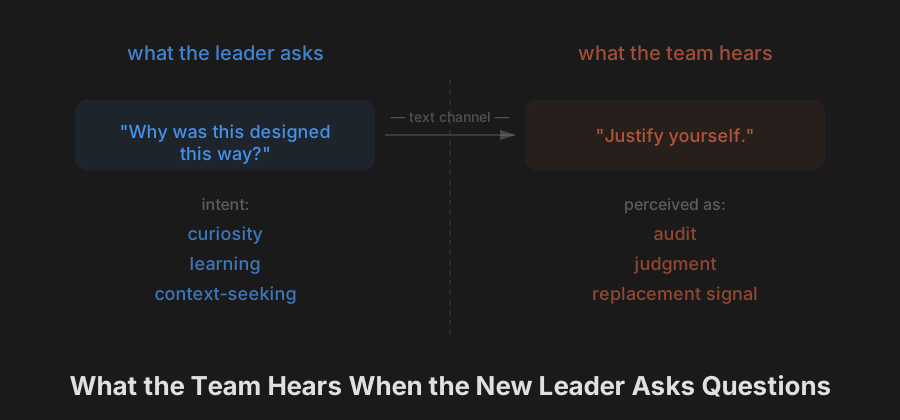
The questions sound like: "Why was this designed this way?"
What the team hears: "Justify yourself."
I know this because I've been that new person. And I've watched the walls go up in real time.
The Threat Response Is Rational
Here's the thing — the team's defensiveness isn't irrational. It's not insecurity. It's pattern recognition.
They've seen this movie before. New leader arrives. Asks lots of questions. Starts "improving" things. Brings in people they trust. The original team gets sidelined. Some leave. Some disengage. The leader calls it "transformation." The team calls it "replacement."
David Rock's SCARF model maps this perfectly. A new leader asking questions threatens almost every dimension simultaneously:
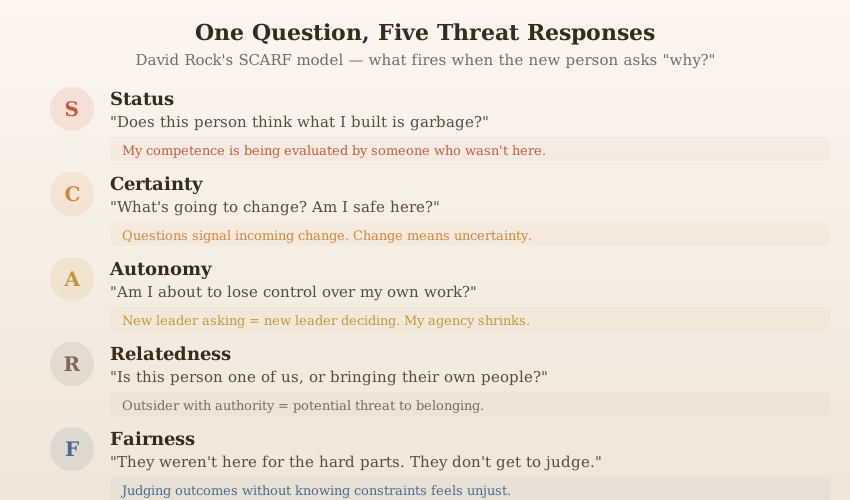
Five threat responses from a single well-intentioned question. That's not a communication problem — it's a neuroscience problem. The brain doesn't distinguish between social threat and physical threat. The amygdala fires either way.
And the "bringing their own people" fear under Relatedness? That one's particularly potent. It's not paranoia — it's a pattern people have witnessed. New leader arrives, slowly introduces "trusted" hires, original team members find themselves on the periphery of decisions they used to own. Whether or not that's the intent, the pattern is so common that the team's threat detection system activates the moment an outsider with authority shows up.
The Outsider's Curiosity Problem
When you've spent years building something — navigating constraints nobody else saw, making trade-offs at 2am during an incident, choosing the least-bad option when every option was bad — your relationship with that system is personal. It's not just code or architecture. It's a record of your judgment under pressure.
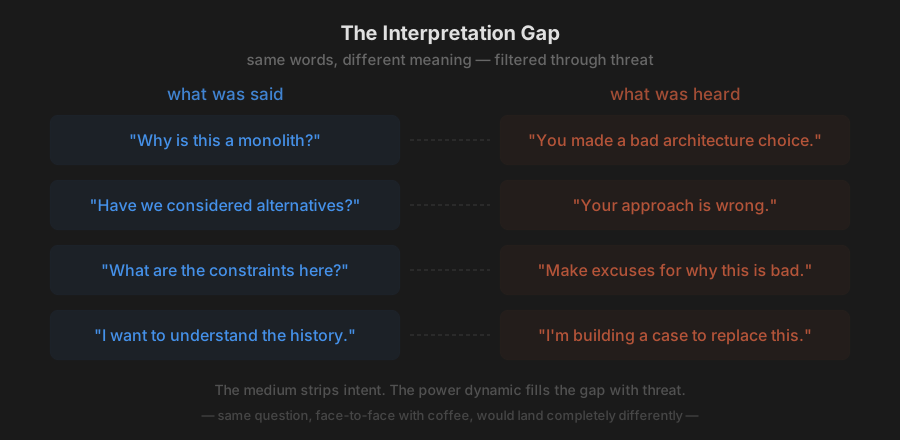
So when someone from outside starts asking "why" — even with genuine curiosity — it doesn't feel like curiosity. It feels like an audit. Every system carries the history of its own evolution. The current state isn't arbitrary — it's the accumulated result of constraints, trade-offs, and interventions over time. You can't understand a system by looking at its current shape alone. You have to understand the forces that shaped it.
That's what I was trying to do — understand the forces. But the team didn't know that. All they saw was the new person questioning the shape.
The Text Communication Trap
And here's where it gets worse: most of this was happening over Slack.
I wrote about this in The Daily Drift — how communication loses context as you move from face-to-face → video → audio → text. In person, curiosity has a face. It has eyebrows raised, a head tilted, a tone that says "I'm genuinely trying to understand." Over text, the same question reads flat. Neutral at best. Interrogative at worst.
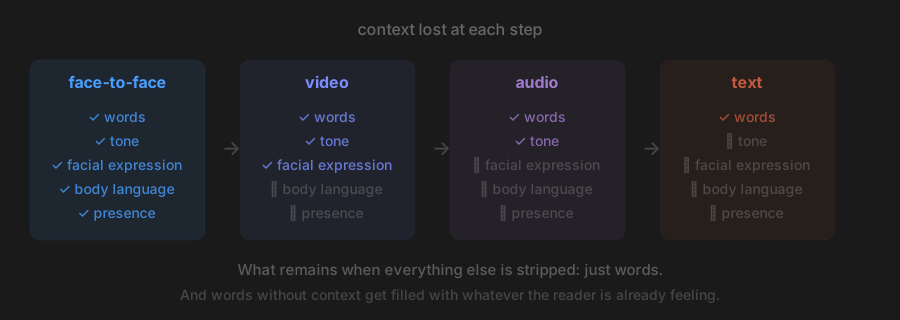
The thing about text is that it strips everything except the words. No tone, no facial expression, no body language. And when the words are ambiguous — which questions always are — the reader fills in the missing context with whatever they're already feeling. If they're feeling safe, they read curiosity. If they're feeling threatened, they read judgment.
The team wasn't misreading my intent because they were paranoid. They were misreading it because the medium made accurate reading almost impossible. And they were already primed for threat.
The Dysfunctions Cascade
Patrick Lencioni's The Five Dysfunctions of a Team starts with vulnerability-based trust — the willingness to say "I don't know," "I was wrong," or "I need help" without it being weaponised.
When a new leader arrives, that trust doesn't exist yet. It hasn't been earned. And I could see the whole cascade playing out: the team wouldn't show me the real problems because they didn't trust my intent. They wouldn't push back on my ideas because conflict with the new person — the one brought in from outside — felt risky. They'd nod along in meetings without actually buying in. And nobody was going to hold each other to new standards that nobody had agreed to in the first place.
I was trying to have honest, open conversations about improvement — but those conversations require trust that didn't exist yet. No wonder it felt like pushing against a wall.
The Moment I Realised
The tension wasn't dramatic. Nobody said anything hostile. It was subtler than that — careful answers, measured responses, the kind of politeness that signals distance rather than warmth. The absence of pushback. The absence of "actually, here's why you're wrong about that."
Healthy teams argue. They challenge. They say "that won't work because..." When a team goes quiet in the face of a new leader's ideas, that's not agreement. That's self-preservation.
I recognised it because I've been on the other side. I've been the person sitting in a room while a new leader "reimagines" the thing I spent two years building. I know what it feels like to hear your work questioned by someone who doesn't know the story behind it. It's not fun. It makes you want to withdraw.
The Thing I Tried First (That Didn't Work)
Before the message, I tried the obvious thing: I showed up with open hands. "How can I help? What can I take off your plate?" I figured if I solved problems for them, that would build trust. Actions over words, right?
So I jumped in. Picked up work. Solved things.
And it made it worse.
Instead of feeling supported, I think the team felt... encroached on. Like I was inserting myself into their space, taking ownership of things that were theirs. The help wasn't asked for — it was offered by someone they hadn't decided to trust yet. And unsolicited help from an outsider with perceived authority doesn't read as generosity. It reads as takeover.
I was confused. I'd come in with open hands and somehow created more distance. The thing that was supposed to build trust had actually eroded it.
That's when I realised: the problem wasn't what I was doing. It was what I hadn't said. The intent behind my actions was invisible. And without stated intent, people fill in their own story — and that story, filtered through the threat response, is rarely generous.
So I wrote a message. Not a strategy doc. Not a retro action item. Just... the honest version of what was in my head.
The Message
I told the team:
When you've spent years building and supporting a system, and then somebody from outside comes in and starts asking questions without fully knowing the history, the struggles, the trade-offs — it naturally feels weird. I completely understand that.
None of the questions are about questioning anyone's decisions, effort, or approach. The intent is purely to understand the constraints and the context behind those hard decisions.
Text communication makes all of this harder. Something that was meant as curiosity can easily come across as adamant, bossy, or negative. That's definitely not the intention.
And then I shared the vision — not as a mandate, but as an invitation:
I don't know if this will work. Maybe some parts won't. But I genuinely believe this team has the capability to drive that kind of transformation. Tell me why it won't work. Tell me the blockers. Tell me the realities on the ground. You can even laugh at the vision — that's totally fine.
What Shifted
The conversations after that message were different. Not overnight-transformation different — more like... the guard came down a few inches.
People started saying "actually, here's the real problem..." instead of the polished version. Someone pushed back on an idea I'd floated — directly, in the channel, not in a private DM. That felt like progress. Disagreement is a sign of safety.
Looking back, I think the message worked because it did something counterintuitive: instead of asserting my position, I named the dynamic that was making everyone uncomfortable. The tension existed. Everyone felt it. Nobody was talking about it. Taking it from subtext to text — "I get why this feels weird" — seemed to release some pressure.
And I think the "you can laugh at it" part mattered more than the vision itself. It signalled that I wasn't precious about being right. Lencioni's vulnerability-based trust requires someone to go first — and when there's a perceived power gap (real or not), that someone has to be the person the team sees as the outsider with influence. I couldn't ask the team to be honest with me if I hadn't been honest with them first.
Ben Horowitz writes in The Hard Thing About Hard Things that the most dangerous thing someone new can do is assume they understand the problem before they understand the context. By explicitly saying "tell me why this won't work," I was trying to invert the default — positioning them as the experts and myself as the learner. Whether that fully landed, I'm not sure. But the tone changed.
The Deeper Pattern
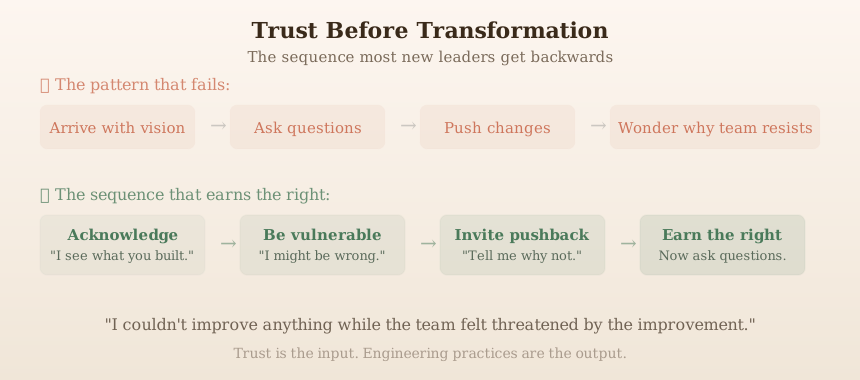
Here's what I keep coming back to: the transformation I wanted — better engineering practices, stronger delivery, improved developer experience — none of it was going to happen through technical decisions alone.
In my experience, I couldn't improve anything while the team felt threatened by the improvement. I couldn't introduce better practices while "better" was being heard as "what you did before was wrong." The first job — at least for me — wasn't the system. It was safety.
There's an emotional version of cognitive load that I think gets overlooked. A team spending mental energy on "is my position safe?" and "does this person respect what I've built?" has no bandwidth left for "how do we make this better?" The threat response eats the improvement capacity.
What I Did Differently After
After that message, I stopped leading with questions. I started leading with acknowledgment. Before asking "why is this designed this way?" I'd say something like "I can see this handles X and Y — what were the constraints when you built it?" Same curiosity, different frame. One sounds like an audit. The other sounds like interest.
I also got more explicit about intent — not once, but repeatedly. Trust isn't built in a single message. It's built through consistent behaviour over time, and early on I was overdrawn. Every interaction was either a deposit or a withdrawal, and I needed a lot of deposits before I'd earned the right to ask the harder questions.
The hardest part was naming the fear directly. At one point I said something like: "I know that when someone new comes in from outside, sometimes the existing team gets sidelined. I want to be clear that's not what's happening here." Saying it out loud didn't make it true — only behaviour over time would do that. But I think naming it showed I was at least aware of their reality, not oblivious to it.
I don't know if I got all of this right. Probably not. But the direction felt correct.
The Ongoing Work
One message didn't fix everything permanently. Trust isn't a switch. It's more like a garden — it needs consistent attention, and it can be damaged faster than it grows.
But that message was a turning point. And the thing I keep thinking about is this: every team carries scar tissue from previous leaders, previous "transformations," previous promises that didn't materialise. When you show up as the new person, you're not just building trust with them — you're rebuilding it on behalf of everyone who broke it before you.
That's the real work. And it starts not with a roadmap or a strategy deck, but with a message that says: I see you. I respect what you've built. I don't have all the answers. Help me understand.