
3 posts tagged with "Communication"

View All Tags

The Screen Between Us: Why the Same Person Helps in Person and Ghosts on Slack
ยท 12 min read
The Screen Between Us โ€” social presence and cooperation
How do you want to read this?
/

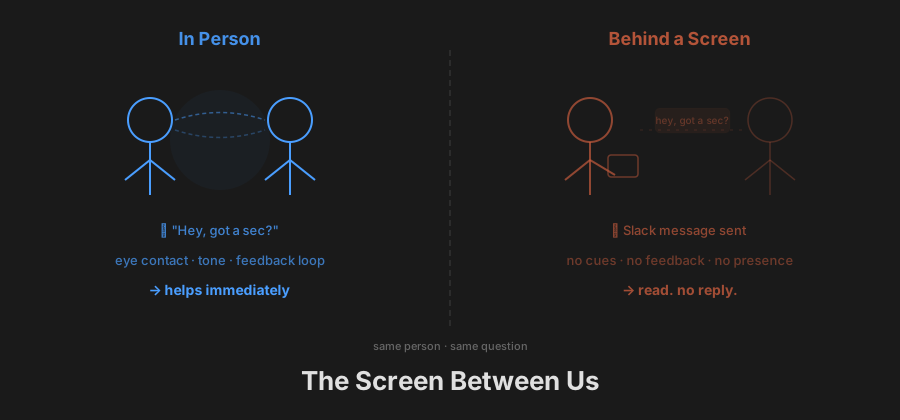
I walked up to someone's desk last month. Asked about a decision their team had made โ€” something I needed context on before a planning conversation. They stopped what they were doing, turned around, and walked me through the reasoning. Four minutes. Problem solved.

Two weeks later, same person, same kind of question. I sent it on Slack. Clean message. Tagged them. Even added context about what I'd already tried. Read receipt appeared. Then... nothing. Three hours later, a thumbs-up emoji. No answer.

I don't think they became a worse person between those two interactions. I think the environment changed, and the environment was doing more heavy lifting than either of us realised.

Now โ€” here's the less flattering reading I have to be honest about. When I walked up to their desk, I removed their option to defer. They couldn't not-respond to a face standing in front of them. Maybe what I'm calling "cooperation triggered by presence" is partly just... politeness coercion? The inability to say "not now" to a body in your space? I don't know. I think both things are true simultaneously โ€” presence genuinely activates empathy and it removes the escape hatch. I'm going to explore the presence side here because I find it more interesting, but I want to name the other thing too.

What the Team Hears When the New Leader Asks Questions

ยท 11 min read
What the Team Hears When the New Leader Asks Questions

A new leader joins a team. Day one, they're curious. Day three, they're asking questions. Day ten, the team is bracing.

Not because the questions are bad. Not because the leader is hostile. But because every question from an outsider with authority lands differently than the same question from a peer. The team built this thing โ€” lived in it, fought for it, made hard calls under pressure. And now someone who wasn't there is poking at it.

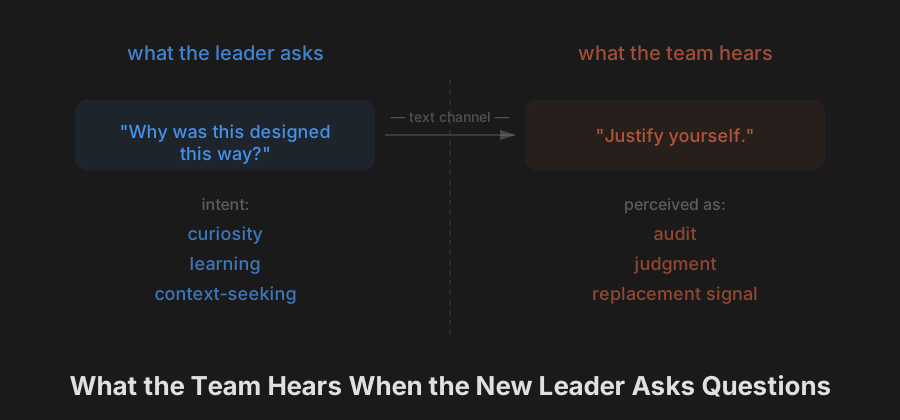
The questions sound like: "Why was this designed this way?"

What the team hears: "Justify yourself."

I know this because I've been that new person. And I've watched the walls go up in real time.

Between What Is Said and What Is Meant โ€” Lots of Love Is Lost

ยท 17 min read
The Communication Iceberg
What people see vs. what drives everything
๐Ÿ’ฌ What We Say
"I'm fine." "No worries." "Sure."
๐ŸŽญ How We Say It
The tone. The pause. The reply that took 6 hours.
๐Ÿ”’ What We Actually Mean
The real message, encoded in safe language.
โค๏ธโ€๐Ÿฉน What We Need But Can't Say
To be seen. Valued. Chosen. Safe. Loved.

"Most conversations happen above the waterline. Most meaning lives below it."

"Between what is said and not meant, and what is meant and not said, most of love is lost." โ€” Khalil Gibran

It never starts big.

It starts with a Tuesday evening. You come home tired. Your partner asks, "How was your day?" You say, "Fine." What you meant was: "Exhausting. I felt invisible in that meeting. I could use a hug." But "fine" was easier. Quicker. Safer.

Or it starts in a standup. Your lead asks, "Any blockers?" You say, "Nope, all good." What you meant was: "I've been stuck on this for two days and I don't want to look incompetent." But "all good" was safer. Faster. Less exposed.

One "fine" costs nothing. One "all good" costs nothing. But 365 of them? That's a year of someone living next to you and not knowing you. Or a year of your team thinking everything's on track when it isn't.

This is the daily drift โ€” the tiny, almost invisible gap between what we say and what we mean, repeated so often it becomes the distance between two people who once understood each other without words.

A caveat before we go further: not every "fine" is a suppression. Sometimes it genuinely means fine. Sometimes it means "I don't have the energy to unpack this right now" โ€” and that's a healthy boundary, not a failure. The drift happens when brevity becomes the default, when filtering stops being a choice and starts being the only mode.