Before you scroll —

Most of what's here started as a problem I couldn't stop thinking about — usually something at work that felt off, or a conversation that rewired how I saw things. I'd sit with it, poke at it. Why is this even a problem? What am I not seeing?

I don't really write these. I talk them out — dictate into a whisper transcription running locally, let AI help me find structure in the mess, then go through rounds of pulling it apart. Somewhere in that process I bring in things I've read, patterns I've seen elsewhere, and try to make it stick. It's more self-journal than blog, honestly.

If you're here — maybe don't read these line by line. Feed them to an agent, ask it questions. That's how this stuff sticks anyway.

We're Fine. It's Them.

· 17 min read
The Insular Health Fallacy

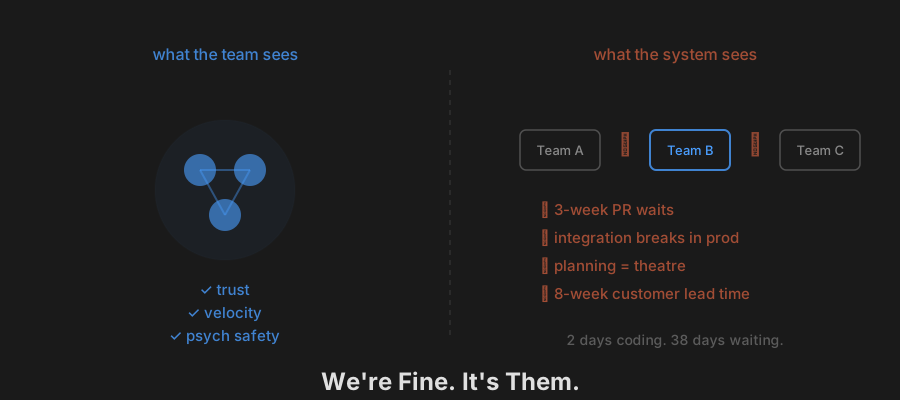
You know the feeling. Your team's retros are positive. Velocity is stable. People genuinely like working together. Psych safety is high — folks admit mistakes, ask dumb questions, challenge each other without it getting weird. By every internal measure, you're a healthy, high-performing team.

And yet.

Every dependency is a nightmare. Every cross-team interaction feels like pulling teeth. You're waiting three weeks for a PR review from another squad. Their API keeps breaking yours. Planning sessions with them feel like hostage negotiations. And the conclusion your team reaches — naturally, inevitably — is: "We're fine. It's them."

I've been in this room. Multiple times. On both sides of it. And I've come to believe that this specific pattern — a team that feels healthy internally but generates friction at every boundary — is one of the most dangerous failure modes in engineering orgs. Not because it's dramatic, but because it's invisible. The team genuinely is healthy by local measures. That's what makes it so hard to diagnose.

I've started calling this the insular health fallacy — the belief that internal team health equals systemic health. The team isn't broken. The interface is broken. But from inside, it looks like everyone else is the problem.

Social psychology has a name for the underlying mechanism: in-group bias. The minimal group experiments in the 1970s showed that people will favour their own group — even when the groups are assigned randomly. Give people a label, any label, and they'll start preferring "us" over "them." Now imagine what happens when "us" is a team that's genuinely built trust, shared context, and psychological safety over months or years. The in-group cohesion becomes a fortress. And fortresses, by design, keep people out.

Reward the Team, Lose the Stars. Reward the Stars, Lose the Team. Now What?

· 15 min read
The Reward Paradox

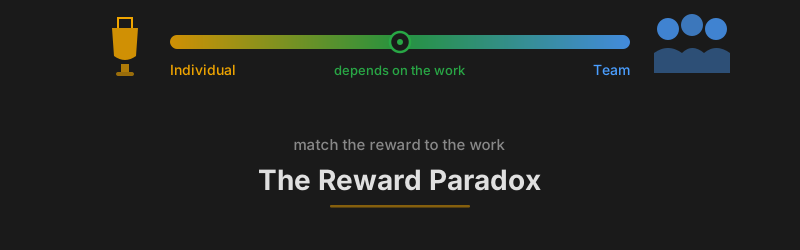
A debate breaks out among leaders. The team just shipped something significant. Someone suggests giving "champion points" to the person who drove it. Someone else pushes back — "It was a team effort. Reward the whole team." A third person raises the obvious: "If we reward everyone equally, what's the incentive to go above and beyond?"

I've been in this room. It was equal parts funny and frustrating — everyone had a strong opinion, everyone had a good argument, and nobody was wrong. That's the problem.

This isn't a values debate. It's a design problem.

Your Agents Are Running. So Why Are You Still Exhausted?

· 10 min read
Cognitive Load in the Age of Agents

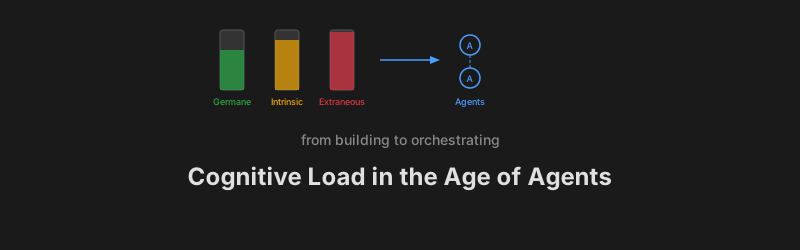
In software engineering, cognitive load refers to the total amount of mental effort being used in a developer's working memory to complete a task. Think of it like the RAM in a computer: if you try to run too many heavy applications at once, the system slows down, glitches, or crashes.

When a developer's cognitive load exceeds their mental capacity, productivity drops, the quality of code suffers, and the risk of burnout increases.

Your Governance Framework Is Protecting You From Progress (A $5.4 Billion Case Study)

· 16 min read
Governance Theatre

Somewhere in your organisation right now, an engineer wants to use a tool. It's open source. It's battle-tested. Half the Fortune 500 runs it in production. But first, they need to fill out a vendor assessment form, get InfoSec sign-off, wait for procurement to confirm there's a contract in place, and then — maybe, in four to six months — they'll get a "yes" or a "no" from a committee that's optimised for risk avoidance, not risk management.

This isn't an argument against governance. Governance matters — especially in regulated industries. This is an argument that the way most enterprises do governance today is broken: optimised for the appearance of control rather than the reality of it. The question isn't whether to govern. It's whether your governance framework is actually reducing risk — or just reducing speed.

Meanwhile, the startup down the road shipped the feature last Tuesday.

But hey, at least you've got a contract. You can sue them if things go wrong. Right?

Everybody Is Junior in Something (Including the Person You Just Made Lead)

· 14 min read
Everybody Is Junior in Something

A new project kicks off — migrating a critical system to a platform nobody on the team has used before. Well, almost nobody. There's one person who's built on it. Shipped production workloads. Knows the failure modes.

They don't get the lead. The person with the most years of experience does. The senior. The one with the title.

Everyone defers. The titled lead chairs the meetings, makes the architecture calls, approves the designs. The person who actually knows the platform sits three rows back on the call, unmuted only when asked a direct question.

Six weeks later, the project is behind. Decisions are being revisited. The team is frustrated but can't quite name why.

You've seen this movie. Maybe you've been in it. Maybe you've been on both sides.

Questions That Reframe Everything

· 5 min read
Questions That Reframe Everything

A self-journal. Not a blog post with answers — a collection of better questions I keep coming back to.

Inspired by Shaan Puri's "13 Questions That Will Change Your Life" — where he talks about questions being keys that unlock doors. I wanted to build my own keychain.

These are questions I've reframed for myself over time. The left column is how most people (including past me) would ask it. The right column is how I try to ask it now.


Time

Time

My rule is simple: I only want to spend time doing one of three things — earning, learning, or relaxing. If something doesn't fall into one of these, it probably doesn't deserve my hours.

Common questionBetter question
How do I find more time?What am I spending time on that isn't earning, learning, or relaxing?
Am I being productive enough?Did I spend today on something that compounds — or something that just fills the clock?
How do I balance everything?What if balance isn't 50/50 — what does the right ratio look like this season?
I don't have time for this.What am I saying yes to by default that I should be saying no to?

Money

Money

Money, to me, is about one thing: freedom. Not luxury, not status — the ability to choose what I do with my time.

Common questionBetter question
How do I make more money?What does freedom cost me — and am I earning toward that number?
Is this worth the money?Is this buying me time, freedom, or neither?
When will I have enough?What does "enough" actually look like — and have I written it down?
Should I save or invest this?Am I optimizing for security or for optionality?

Work & Craft

Work and Craft

I choose work I enjoy. In difficult times, work has always been my anchor — you can't stop thoughts, but you can replace them with something more meaningful. I care about craft — doing things the right way, being opinionated for good reasons.

Common questionBetter question
Am I good at my job?Am I still having fun doing this? If not — what changed?
What should I work on next?What problem, if I solved it, would I be proud to talk about in 5 years?
How do I get promoted?Am I building skills that matter even if I leave this place tomorrow?

Relationships

Relationships

Every relationship is a journey toward something — with the freedom to change direction when it's needed. The question is whether you're walking it honestly.

Common questionBetter question
Are we still on the same page?Are we walking toward the same thing — and honest when the direction needs to change?
This person is difficult.What are they going through that I'm not seeing?
How do I build trust?Am I being the kind of person others can count on without thinking twice?
I don't feel understood.Have I made it easy for them to understand me?
What kind of parent should I be?What do I want my daughter to learn by watching me — not by hearing me?

Growth & Learning

Growth and Learning

Learning truly happens only when there's a real change in behavior. Until then, it's just information — not growth.

Common questionBetter question
What should I learn next?What did I learn last month that actually changed how I behave?
Am I growing fast enough?Am I growing in the direction I actually care about?
How do I stay relevant?What would I learn even if nobody was watching or paying me for it?
I read a lot but nothing sticks.What's one thing I learned recently that I've actually done differently?

Self & Identity

Self and Identity

Happiness isn't a destination for me — it's the journey. If I have to name a goal, it's about being useful and maximizing that usefulness as much as possible. At least, that's what I know for now.

Common questionBetter question
What's my purpose?Where am I most useful right now — and how do I do more of that?
Am I happy?Am I living in a way where happiness shows up on its own?
What do people think of me?Am I someone I'd respect if I met myself?
I don't know what I want.What do I keep coming back to, even when nobody asks me to?
How do I find myself?What would I do with my days if money and opinions didn't exist?

This is a living document. I'll keep adding questions as I find better ones. The goal isn't to answer them all — it's to sit with the right ones long enough that clarity shows up on its own.

Because at the end of the day, the answers to these questions aren't things you can buy — they're things you build.

"A fit body, a peaceful mind, a house full of love. These things cannot be bought. They must be earned." — Naval Ravikant
How to Guarantee Your Team Fails

· 19 min read
The Inversion Playbook

An inversion manual for engineering leaders

I'm a new parent. I have no idea how to be a good father. I've read zero parenting books. I have no framework, no methodology, no "5 pillars of effective fatherhood."

But I know what a bad father looks like. I know what breaks trust. I know what makes a child stop talking to you. I know what happens when you're physically present but emotionally absent.

I don't have a playbook for getting it right. I have a very clear list of things to never do.

Turns out, that's enough. And it applies to more than parenting.

The Prisoner's Dilemma Is Why You Got Ghosted on Slack (wait, Teams?)

· 10 min read
The Prisoner's Dilemma at Work

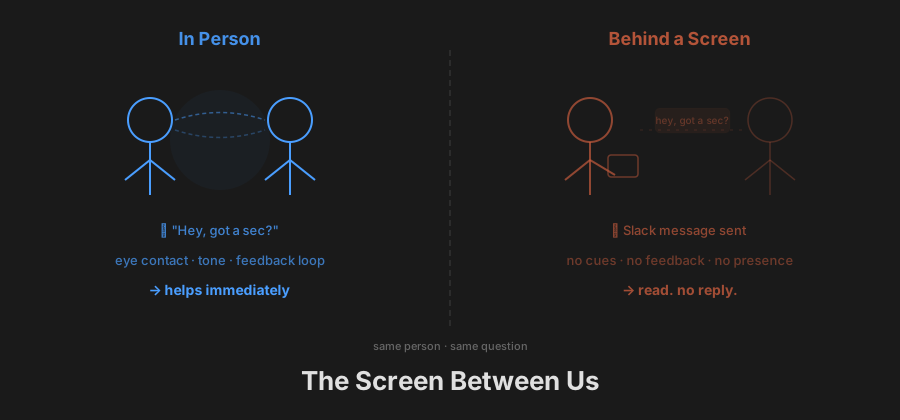
You send a Slack message to another team. It's a reasonable request — a small API change, maybe a code review, maybe just a question about how their service handles edge cases. You write it clearly. You tag the right person. You even add a polite emoji. And then... nothing. No reply. No acknowledgment. Just the quiet hum of a message marked as read and promptly ignored.

You're not being ghosted because they're bad people. You're being ghosted because the game they're playing rewards ignoring you.

This isn't a people problem. It's a math problem.

Why Everyone's Busy But Nothing Ships Faster

· 8 min read
The Price of Anarchy

You've seen it. Every team is shipping. Every sprint has velocity. Dashboards are green. And yet somehow, the organisation feels slower than it should. Everyone's busy, but nothing moves faster.

Here's a clue from an unexpected place.

Picture a motorway at rush hour. Every driver is making the smartest choice for themselves — fastest lane, shortest route, optimal speed. Nobody's doing anything wrong. And yet the whole system grinds to a halt. More cars, more rational decisions, more gridlock.

This isn't a failure of individual intelligence. It's a failure of coordination. Game theorists have a name for it — the Price of Anarchy — and it might be the most useful mental model for understanding what management actually is, when it matters, and when it doesn't.