13 posts tagged with "Culture"

View All Tags

The Screen Between Us: Why the Same Person Helps in Person and Ghosts on Slack
· 12 min read
The Screen Between Us — social presence and cooperation
How do you want to read this?
/

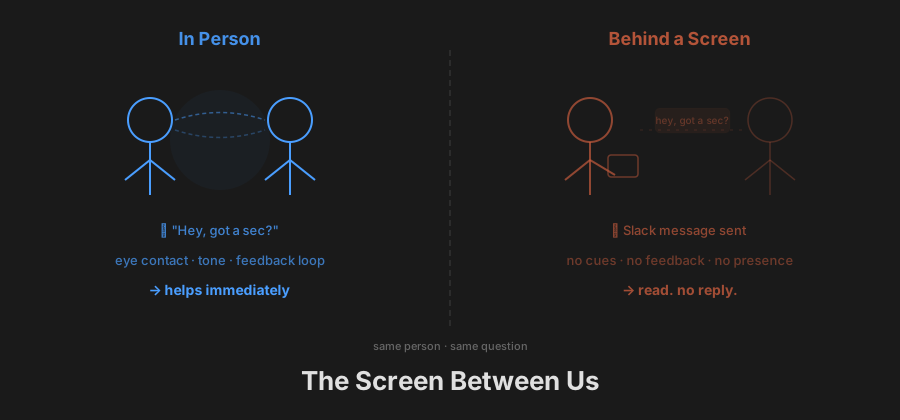
I walked up to someone's desk last month. Asked about a decision their team had made — something I needed context on before a planning conversation. They stopped what they were doing, turned around, and walked me through the reasoning. Four minutes. Problem solved.

Two weeks later, same person, same kind of question. I sent it on Slack. Clean message. Tagged them. Even added context about what I'd already tried. Read receipt appeared. Then... nothing. Three hours later, a thumbs-up emoji. No answer.

I don't think they became a worse person between those two interactions. I think the environment changed, and the environment was doing more heavy lifting than either of us realised.

Now — here's the less flattering reading I have to be honest about. When I walked up to their desk, I removed their option to defer. They couldn't not-respond to a face standing in front of them. Maybe what I'm calling "cooperation triggered by presence" is partly just... politeness coercion? The inability to say "not now" to a body in your space? I don't know. I think both things are true simultaneously — presence genuinely activates empathy and it removes the escape hatch. I'm going to explore the presence side here because I find it more interesting, but I want to name the other thing too.
We're Fine. It's Them.

· 17 min read
The Insular Health Fallacy

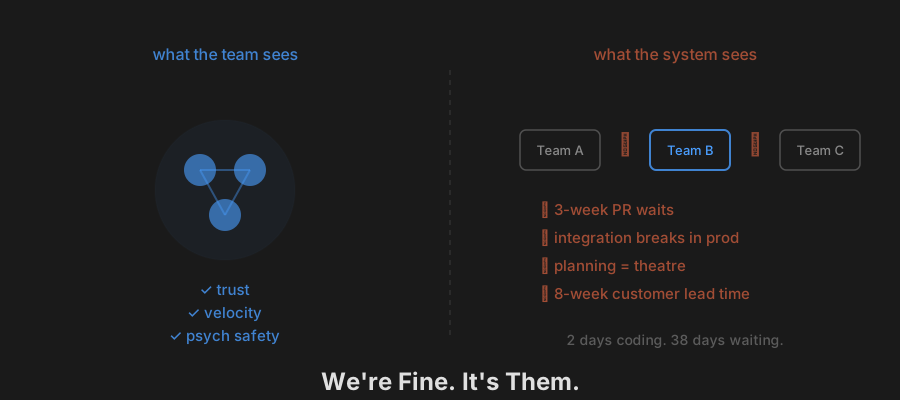
You know the feeling. Your team's retros are positive. Velocity is stable. People genuinely like working together. Psych safety is high — folks admit mistakes, ask dumb questions, challenge each other without it getting weird. By every internal measure, you're a healthy, high-performing team.

And yet.

Every dependency is a nightmare. Every cross-team interaction feels like pulling teeth. You're waiting three weeks for a PR review from another squad. Their API keeps breaking yours. Planning sessions with them feel like hostage negotiations. And the conclusion your team reaches — naturally, inevitably — is: "We're fine. It's them."

I've been in this room. Multiple times. On both sides of it. And I've come to believe that this specific pattern — a team that feels healthy internally but generates friction at every boundary — is one of the most dangerous failure modes in engineering orgs. Not because it's dramatic, but because it's invisible. The team genuinely is healthy by local measures. That's what makes it so hard to diagnose.

I've started calling this the insular health fallacy — the belief that internal team health equals systemic health. The team isn't broken. The interface is broken. But from inside, it looks like everyone else is the problem.

Social psychology has a name for the underlying mechanism: in-group bias. The minimal group experiments in the 1970s showed that people will favour their own group — even when the groups are assigned randomly. Give people a label, any label, and they'll start preferring "us" over "them." Now imagine what happens when "us" is a team that's genuinely built trust, shared context, and psychological safety over months or years. The in-group cohesion becomes a fortress. And fortresses, by design, keep people out.

Reward the Team, Lose the Stars. Reward the Stars, Lose the Team. Now What?

· 15 min read
The Reward Paradox

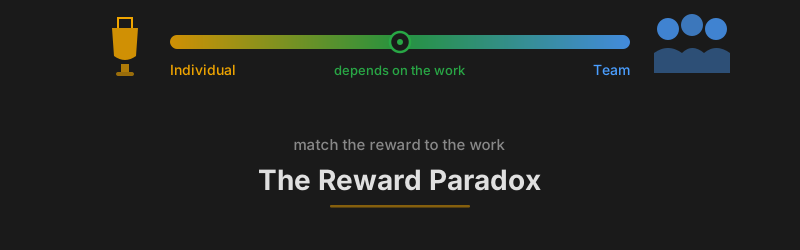
A debate breaks out among leaders. The team just shipped something significant. Someone suggests giving "champion points" to the person who drove it. Someone else pushes back — "It was a team effort. Reward the whole team." A third person raises the obvious: "If we reward everyone equally, what's the incentive to go above and beyond?"

I've been in this room. It was equal parts funny and frustrating — everyone had a strong opinion, everyone had a good argument, and nobody was wrong. That's the problem.

This isn't a values debate. It's a design problem.

Your Agents Are Running. So Why Are You Still Exhausted?

· 10 min read
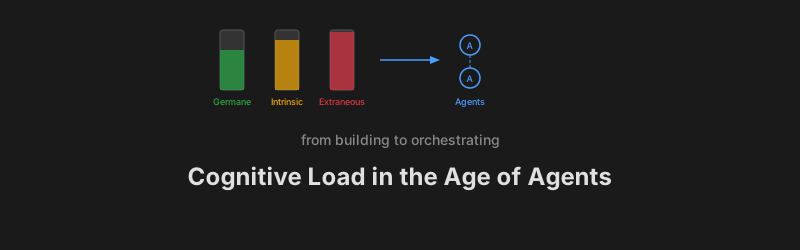
Cognitive Load in the Age of Agents

In software engineering, cognitive load refers to the total amount of mental effort being used in a developer's working memory to complete a task. Think of it like the RAM in a computer: if you try to run too many heavy applications at once, the system slows down, glitches, or crashes.

When a developer's cognitive load exceeds their mental capacity, productivity drops, the quality of code suffers, and the risk of burnout increases.

Your Governance Framework Is Protecting You From Progress (A $5.4 Billion Case Study)

· 16 min read
Governance Theatre

Somewhere in your organisation right now, an engineer wants to use a tool. It's open source. It's battle-tested. Half the Fortune 500 runs it in production. But first, they need to fill out a vendor assessment form, get InfoSec sign-off, wait for procurement to confirm there's a contract in place, and then — maybe, in four to six months — they'll get a "yes" or a "no" from a committee that's optimised for risk avoidance, not risk management.

This isn't an argument against governance. Governance matters — especially in regulated industries. This is an argument that the way most enterprises do governance today is broken: optimised for the appearance of control rather than the reality of it. The question isn't whether to govern. It's whether your governance framework is actually reducing risk — or just reducing speed.

Meanwhile, the startup down the road shipped the feature last Tuesday.

But hey, at least you've got a contract. You can sue them if things go wrong. Right?

What the Team Hears When the New Leader Asks Questions

· 11 min read
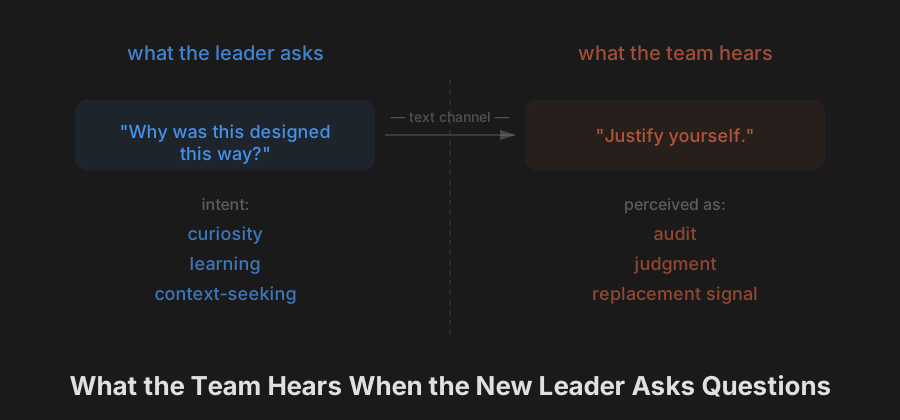
What the Team Hears When the New Leader Asks Questions

A new leader joins a team. Day one, they're curious. Day three, they're asking questions. Day ten, the team is bracing.

Not because the questions are bad. Not because the leader is hostile. But because every question from an outsider with authority lands differently than the same question from a peer. The team built this thing — lived in it, fought for it, made hard calls under pressure. And now someone who wasn't there is poking at it.

The questions sound like: "Why was this designed this way?"

What the team hears: "Justify yourself."

I know this because I've been that new person. And I've watched the walls go up in real time.

Everybody Is Junior in Something (Including the Person You Just Made Lead)

· 14 min read
Everybody Is Junior in Something

A new project kicks off — migrating a critical system to a platform nobody on the team has used before. Well, almost nobody. There's one person who's built on it. Shipped production workloads. Knows the failure modes.

They don't get the lead. The person with the most years of experience does. The senior. The one with the title.

Everyone defers. The titled lead chairs the meetings, makes the architecture calls, approves the designs. The person who actually knows the platform sits three rows back on the call, unmuted only when asked a direct question.

Six weeks later, the project is behind. Decisions are being revisited. The team is frustrated but can't quite name why.

You've seen this movie. Maybe you've been in it. Maybe you've been on both sides.

How to Guarantee Your Team Fails

· 19 min read
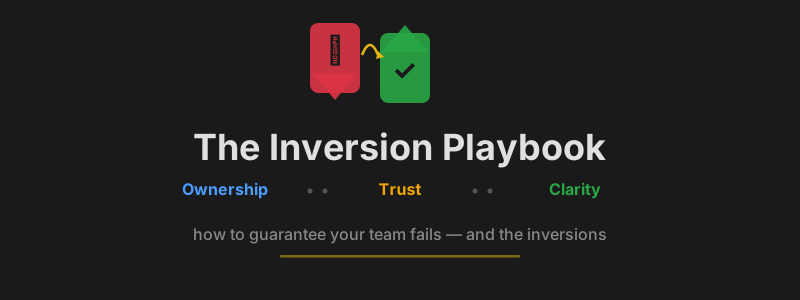
The Inversion Playbook

An inversion manual for engineering leaders

I'm a new parent. I have no idea how to be a good father. I've read zero parenting books. I have no framework, no methodology, no "5 pillars of effective fatherhood."

But I know what a bad father looks like. I know what breaks trust. I know what makes a child stop talking to you. I know what happens when you're physically present but emotionally absent.

I don't have a playbook for getting it right. I have a very clear list of things to never do.

Turns out, that's enough. And it applies to more than parenting.

The Prisoner's Dilemma Is Why You Got Ghosted on Slack (wait, Teams?)

· 10 min read
The Prisoner's Dilemma at Work

You send a Slack message to another team. It's a reasonable request — a small API change, maybe a code review, maybe just a question about how their service handles edge cases. You write it clearly. You tag the right person. You even add a polite emoji. And then... nothing. No reply. No acknowledgment. Just the quiet hum of a message marked as read and promptly ignored.

You're not being ghosted because they're bad people. You're being ghosted because the game they're playing rewards ignoring you.

This isn't a people problem. It's a math problem.